Lower Yakima Valley / Yakima County · 509
Bat removal in Grandview, Washington
Grandview sits on the north side of the Lower Yakima Valley between Sunnyside and Prosser, fed by the Sunnyside Canal and surrounded by orchards, vineyards and the food-processing plants that anchor its economy. The city calls itself the third-largest city in Yakima County, and Washington OFM puts its April 1, 2026 population at 12,280, up from 10,910 at the 2020 census. Washington DOH’s 2026 rabies table lists a rabid bat collected in Yakima County in September 2026, a reminder that bats in Lower Valley homes are a health question as well as a nuisance. Washington Wildlife Specialists handles Grandview attic, wall, shop and outbuilding exclusions with inspection-first, one-way methods and a two-year written warranty on whole-structure work.
Local housing & attic patterns in Grandview
HistoryLink records that two small settlements, one near today’s Bethany Road and one near Euclid Street, came together in 1906 when the Granger Land Company platted the town site, and that the first building, a combined home, boarding house and post office, went up on Division Street that May. Residents voted 37 to 3 to incorporate in September 1909, and the first Oregon-Washington Railroad & Navigation Company train came through on March 22, 1911. That history shows in the housing: early wood-frame homes and brick commercial buildings around Division Street and downtown, mid-century ranches on the surrounding grid, and newer subdivisions on the edges of town, with farm shops, packing sheds, barns and pole buildings on the irrigated ground beyond. Older homes tend to leak at gable vents, fascia corners, chimney flashing and where porches or additions meet the original roof. Newer homes fail at ridge-vent ends, soffit returns, stucco and stone transitions and garage tie-ins. Ag buildings add long ridge caps, metal-panel seams, open eaves and vent stacks. We inspect the house, the attic and any outbuilding on the property.
Bat seasonality around Grandview
WDFW says Washington bats enter hibernation sites in late September or October and stay until April or early May, and pups are raised in nursery colonies starting around May. Grandview sees about 300 sunny days and roughly 10 inches of precipitation a year by the city’s own figures, so attics and wall cavities heat up early and colonies build quickly, peaking in July and August, when droppings, odor and squeaking get noticed. One-way exclusion fits mid-August to mid-October, after the young can fly, or early spring before births. WDFW advises leaving bats found hibernating in a building after October 15 alone until spring, so a November or winter call usually means an inspection, sealing any routes into living space now, and scheduling the full exclusion for the next window.
Neighborhoods & landmarks we know
We work throughout Grandview: downtown and the older blocks around Division Street and Second Street near City Hall, the residential grid north toward Bethany Road and the Sunnyside Canal, the Euclid Road area, neighborhoods near Country Park (home of the Yakima Valley Fair & Rodeo) and Black Rock Creek Golf Course, newer subdivisions on the edges of town, and the farm, orchard, vineyard and processing properties around the city. Sunnyside, Prosser, Mabton and Granger addresses are on the same Lower Valley route; call with the address to confirm scheduling.
Why hire a local eastern Washington crew
An early-1900s house near Division Street, a 2000s subdivision home and a steel shop on farm ground each fail in different places, and we scope and price each one on its own. Valley heat, wind and dust break down cheap foam and caulk, so we seal with exclusion-grade materials matched to the siding and trim. For packing, processing and other ag buildings we can phase work around harvest and production schedules and photograph every entry for owners and managers. We run Grandview on the same route as Sunnyside and Prosser, time every exclusion to WDFW guidance, and back whole-structure work with a two-year written warranty.
- Bat specialists since 2011 — bats are our flagship service
- Documented inspection: openings numbered, photographed, primary vs. secondary
- Targeted repair or whole-structure seal (warranty on whole-structure)
- Humane one-way exclusion · WDFW-aware timing (May–August maternity)
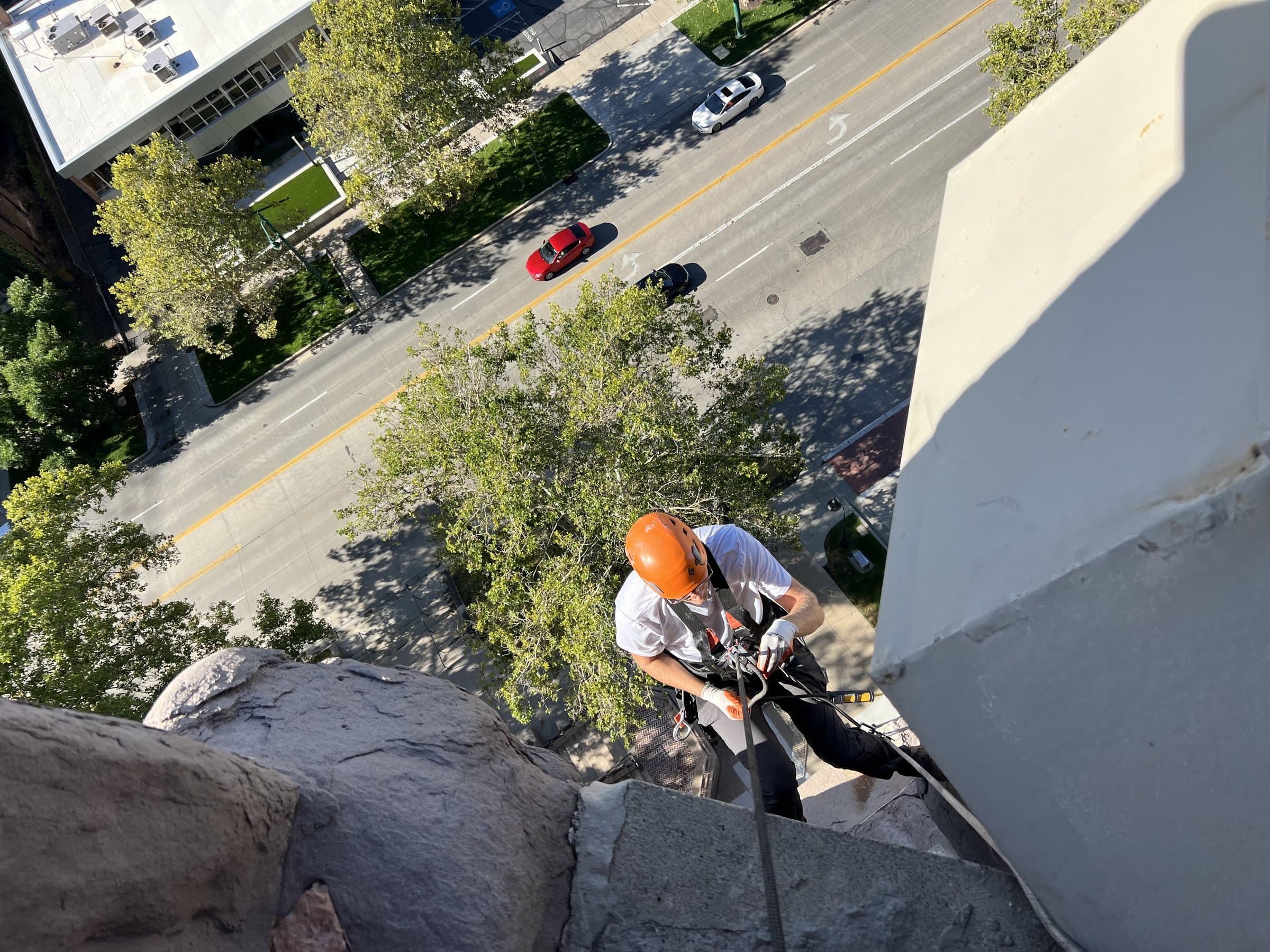
- High-rise / rope-access capacity for elevated buildings
- We finish failed prior jobs—remove old foam and devices
- Two-year written warranty on sealed whole-structure work
- Local eastern WA ownership, backed by a multi-state team
Typical Grandview jobs start with a phone consultation, then an attic inspection, followed by humane exclusion and optional guano cleanup. Commercial properties can use our commercial bat removal program.
Local bat facts for Grandview
HistoryLink says Grandview took its name from the view of the Cascade peaks that railroad and land-company scouts admired from the site, was platted in 1906, and was certified as a town on September 20, 1909 after a 37–3 vote. Washington OFM puts Grandview’s April 1, 2026 population at 12,280, up from 10,910 at the 2020 census. Under WAC 220-200-100 bats are protected wildlife, but bats in or right next to an occupied building may be removed without a permit.
Who to call in Grandview
- Bat in the house or any bat contact: Yakima Health District, 509-249-6541 (business hours) or 509-575-4040, press 1 (after hours). 1210 Ahtanum Ridge Drive, Union Gap.
- Pets and domestic animals: Grandview Police Department (handles animal control inside city limits), dispatch 509-882-2000, 201 W. Second Street; Yakima Humane Society 509-457-6854. Unincorporated Yakima County: Yakima County Animal Control, 509-574-2420. Not bat removal.
- Wildlife questions: WDFW South Central Region 3 office, 1701 S. 24th Ave., Yakima, 509-575-2740 (serves Yakima County).
- Bats living in the attic or walls: A private wildlife control operator. WDFW does not remove bats; it refers homeowners to nuisance wildlife control operators.
Sources
- Yakima Health District – Contact & 24/7 reporting line
- City of Grandview – Animal Control
- City of Grandview – Police Department
- City of Grandview – Quick Facts
- Yakima Humane Society – Animal control contacts
- HistoryLink – Grandview thumbnail history
- HistoryLink – Grandview’s incorporation is certified (1909)
- Washington State DOH – Rabies activity in Washington
- WDFW – Regional offices (South Central Region 3)
- WDFW – Hiring a Wildlife Control Operator
- WDFW – Living with wildlife: Bats
- Washington OFM – April 1, 2026 population of cities, towns and counties
- WAC 220-200-100 – Wildlife classified as protected
Grandview bat removal FAQ
Grandview & the Lower Yakima Valley
- Sunnyside bat removal
Lower Yakima Valley / Yakima County
- Prosser bat removal
Lower Yakima Valley / Benton County
- Benton City bat removal
Lower Yakima Valley / Benton County
- Zillah bat removal
Lower Yakima Valley / Yakima County
- Toppenish bat removal
Lower Yakima Valley / Yakima County
- Yakima bat removal
Yakima Valley
- Union Gap bat removal
Upper Yakima Valley / Yakima County
- Selah bat removal
Upper Yakima Valley / Yakima County
- West Richland bat removal
Tri-Cities / Benton County
- Richland bat removal
Tri-Cities
- Kennewick bat removal
Tri-Cities / Benton County
- Ellensburg bat removal
Kittitas Valley / Kittitas County
- All service areas
Eastern Washington hub
- Why us
Proof points & team
- How we work
Process steps
- Warranty
Two-year coverage
- FAQ
Common questions
Bat problems in Grandview? Let's talk.
Humane exclusion for Grandview and the surrounding Lower Yakima Valley / Yakima County. Two-year written warranty on whole-structure work. Same-day often available across the 509.