Upper Yakima Valley / Yakima County · 509
Bat removal in Union Gap, Washington
Union Gap sits on Yakima’s southern edge, at the gap between Ahtanum Ridge and Rattlesnake Ridge where the Yakima River leaves the Upper Valley. HistoryLink calls it the first and oldest town in Yakima County: settlers stopped here in 1865, the village became Yakima City and the county seat, and it incorporated in 1883 before the Northern Pacific bypassed it and most of the town was moved to North Yakima. The legislature renamed what was left Union Gap in 1917. Washington OFM puts Union Gap’s April 1, 2026 population at 6,680, up from 6,568 at the 2020 census. Washington DOH’s 2026 rabies table lists a rabid bat collected in Yakima County in September 2026, so a bat in a Union Gap home is a health question as well as a nuisance. Washington Wildlife Specialists handles Union Gap attic, wall, shop and commercial exclusions with inspection-first, one-way methods and a two-year written warranty on whole-structure work.
Local housing & attic patterns in Union Gap
HistoryLink says Union Gap’s population fell to under 200 after the railroad left, took until 1930 to pass 500 again, reached nearly 1,000 by 1940, 2,100 by 1960 and 3,184 by 1980, and topped 6,000 by the 2010 census. That slow growth shows in the building stock: a few older homes in the original townsite, including two on the National Register (the Elizabeth Louden Carmichael House on W. Pine Street and the Alexander McAllister House on W. White Street), postwar and mid-century houses, later ranch homes and apartments, and a large commercial and light-industrial base, since HistoryLink notes the Valley Mall alongside I-82 is the Yakima Valley’s largest mix of shops and services. Older wood-frame homes leak at gable vents, fascia corners, chimney flashing and where additions meet the original roof. Ranches fail at soffit returns, garage tie-ins and roof-to-wall transitions. Flat-roof and metal commercial buildings, warehouses and ag shops add long parapet, ridge-cap and panel-seam gaps that bats use for years before anyone notices.
Bat seasonality around Union Gap
WDFW says Washington bats enter hibernation sites in late September or October and stay until April or early May, and pups are raised in nursery colonies starting around May. In the hot, dry Yakima Valley summer, south- and west-facing attics, wall cavities and metal-sided buildings warm quickly, and colonies are at their largest in July and August, when droppings, odor and squeaking get noticed. One-way exclusion fits mid-August to mid-October, after the young can fly, or early spring before births. WDFW advises leaving bats found hibernating in a building after October 15 alone until spring, so a November or winter call in Union Gap usually means an inspection, sealing any routes into living space now, and scheduling the full exclusion for the next window.
Neighborhoods & landmarks we know
We work throughout Union Gap: the original townsite and the blocks around Main Street and W. Ahtanum Road near City Hall and the police station, the residential streets toward Ahtanum Ridge, the Valley Mall and Main Street retail corridor, the business parks and warehouses along the freeway and the Yakima River, the area around Fulbright Park and the Central Washington Agricultural Museum, and homes and outbuildings on the unincorporated edges toward Ahtanum, Moxee and Parker. Yakima, Selah, Moxee and Wapato addresses are on the same Upper Valley route; call with the address to confirm scheduling.
Why hire a local eastern Washington crew
An older house on the original townsite, a 1970s ranch off Ahtanum Road and a metal warehouse near the freeway each fail in different places, and we scope and price each one on its own. Valley heat, wind and dust break down cheap foam and caulk, so we seal with exclusion-grade materials matched to the siding and trim, never expanding spray foam. For retail, warehouse and ag buildings we can plan work around business hours and photograph every entry for owners and property managers. We run Union Gap on the same route as Yakima and Selah, time every exclusion to WDFW guidance, and back whole-structure work with a two-year written warranty.
- Bat specialists since 2011 — bats are our flagship service
- Documented inspection: openings numbered, photographed, primary vs. secondary
- Targeted repair or whole-structure seal (warranty on whole-structure)
- Humane one-way exclusion · WDFW-aware timing (May–August maternity)
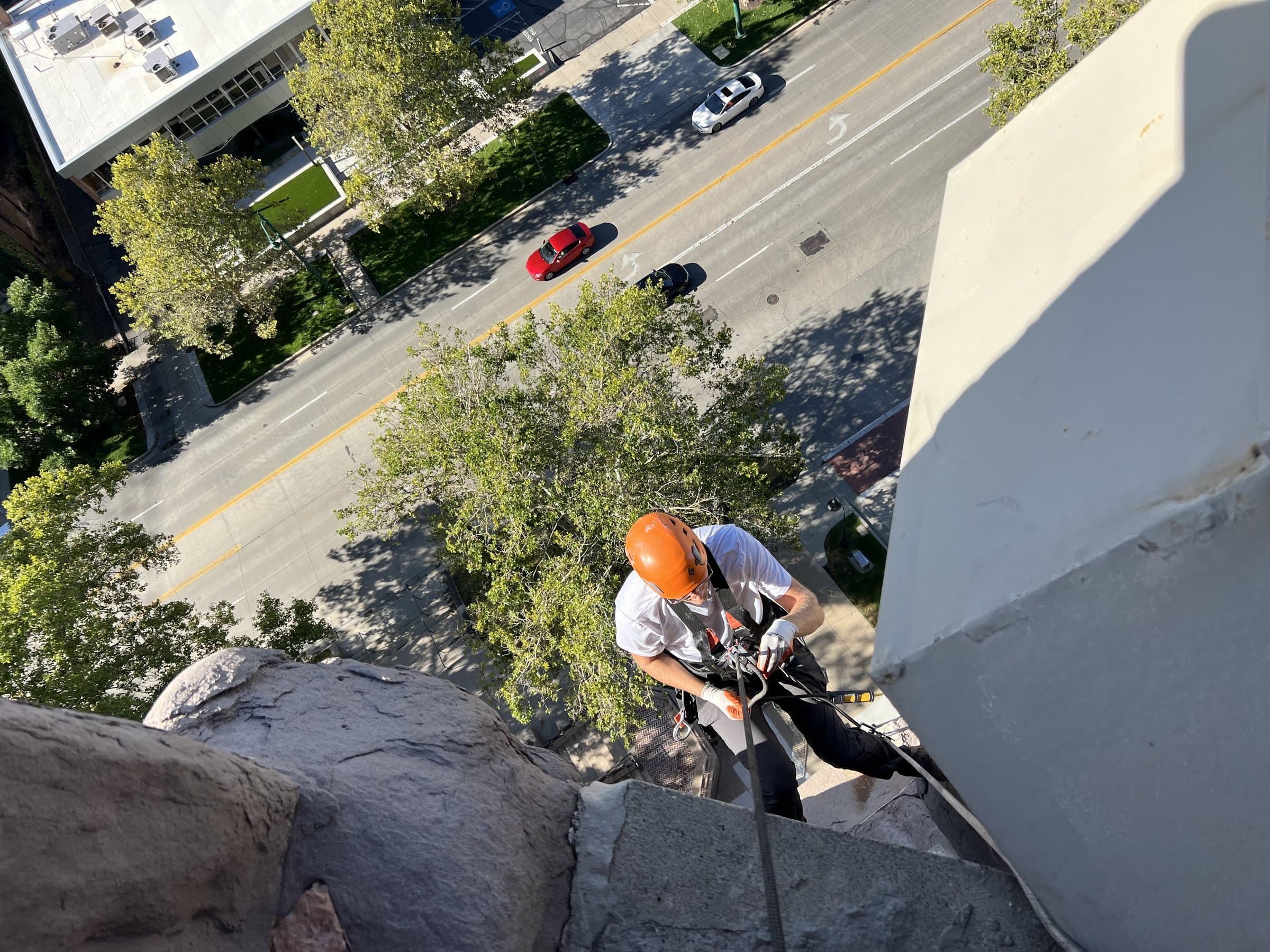
- High-rise / rope-access capacity for elevated buildings
- We finish failed prior jobs—remove old foam and devices
- Two-year written warranty on sealed whole-structure work
- Local eastern WA ownership, backed by a multi-state team
Typical Union Gap jobs start with a phone consultation, then an attic inspection, followed by humane exclusion and optional guano cleanup. Commercial properties can use our commercial bat removal program.
Local bat facts for Union Gap
HistoryLink says the Northern Pacific reached Yakima City in December 1884 but built its depot at a new townsite about four miles away, and that more than 100 buildings were moved on rollers to North Yakima over the winter of 1884–85. The legislature renamed Yakima City “Union Gap” in 1917. Washington OFM puts Union Gap’s April 1, 2026 population at 6,680, up from 6,568 at the 2020 census. Under WAC 220-200-100 bats are protected wildlife, but bats in or right next to an occupied building may be removed without a permit.
Who to call in Union Gap
- Bat in the house or any bat contact: Yakima Health District, 509-249-6541 (business hours) or 509-575-4040, press 1 (after hours). 1210 Ahtanum Ridge Drive, Union Gap.
- Pets and domestic animals: Union Gap Police Department (animal control contracted with the Humane Society of Central Washington; dogs and cats only), 102 W. Ahtanum Road, 509-248-0430, weekdays 8 a.m.–5 p.m.; after hours the line transfers to SUNCOMM. Unincorporated Yakima County: Yakima County Animal Control, 509-574-2420.
- Wildlife questions: WDFW South Central Region 3 office, 1701 S. 24th Ave., Yakima, 509-575-2740 (serves Yakima County).
- Bats living in the attic or walls: A private wildlife control operator. WDFW does not remove bats; it refers homeowners to nuisance wildlife control operators.
Sources
- Yakima Health District – Contact & 24/7 reporting line
- City of Union Gap Police – FAQ (animal complaints, after-hours line)
- City of Union Gap – Contact
- HistoryLink – Union Gap thumbnail history
- HistoryLink – Northern Pacific reaches Yakima City (1884)
- Washington State DOH – Rabies activity in Washington
- Washington State DOH – Rabies
- WDFW – Regional offices (South Central Region 3)
- WDFW – Hiring a Wildlife Control Operator
- WDFW – Living with wildlife: Bats
- Washington OFM – April 1, 2026 population of cities, towns and counties
- WAC 220-200-100 – Wildlife classified as protected
Union Gap bat removal FAQ
Union Gap & the Upper Yakima Valley
- Yakima bat removal
Yakima Valley
- Selah bat removal
Upper Yakima Valley / Yakima County
- Moxee bat removal
Moxee Valley / Yakima County
- Wapato bat removal
Lower Yakima Valley / Yakima County
- Zillah bat removal
Lower Yakima Valley / Yakima County
- Toppenish bat removal
Lower Yakima Valley / Yakima County
- Sunnyside bat removal
Lower Yakima Valley / Yakima County
- Grandview bat removal
Lower Yakima Valley / Yakima County
- Ellensburg bat removal
Kittitas Valley / Kittitas County
- Prosser bat removal
Lower Yakima Valley / Benton County
- Wenatchee bat removal
Wenatchee Valley / Chelan County
- All service areas
Eastern Washington hub
- Why us
Proof points & team
- How we work
Process steps
- Warranty
Two-year coverage
- FAQ
Common questions
Bat problems in Union Gap? Let's talk.
Humane exclusion for Union Gap and the surrounding Upper Yakima Valley / Yakima County. Two-year written warranty on whole-structure work. Same-day often available across the 509.