Upper Yakima Valley / Yakima County · 509
Bat removal in Selah, Washington
Selah sits just north of Yakima above the confluence of the Naches and Yakima rivers, and HistoryLink says its name comes from a word meaning “still or smooth water.” Known for orchards and as the “Apple Juice Capitol of the World” since the Tree Top co-operative took over the local juice plant in 1960, it is also a bedroom community for Yakima. Washington OFM puts Selah’s April 1, 2026 population at 8,680, up from 8,153 at the 2020 census. Washington DOH’s 2026 rabies table lists a rabid bat collected in Yakima County in September 2026, so a bat in a Selah home is a health question as well as a nuisance. Washington Wildlife Specialists handles Selah attic, wall, shop and outbuilding exclusions with inspection-first, one-way methods and a two-year written warranty on whole-structure work.
Local housing & attic patterns in Selah
HistoryLink traces Selah’s town center to a store Frank Charbonneau opened at a valley crossroads in 1905, a fire that burned most of the young business district in 1908, a rebuilt main street that by 1912 had a bank, drug store, livery and newspaper, and the 1913 interurban line from North Yakima. The town incorporated on March 17, 1919. Its population was under 800 in 1930 and passed 2,500 by the end of the 1950s, then surged again in the 1970s as Yakima commuters moved in, fast enough that the school district asked for a pause on new home construction. That history shows up in the housing: early wood-frame homes and older commercial buildings near First Street and Naches Avenue, postwar and 1950s houses, a large stock of 1970s and later ranches and split-levels, and newer subdivisions, with shops, barns and orchard buildings on the East Selah and Wenas Valley acreage. Older homes leak at gable vents, fascia corners, chimney flashing and where additions meet the original roof. Split-levels and ranches fail at soffit returns, garage tie-ins and roof-to-wall transitions. Shops and pole buildings add long ridge caps, panel seams and open eaves.
Bat seasonality around Selah
WDFW says Washington bats enter hibernation sites in late September or October and stay until April or early May, and pups are raised in nursery colonies starting around May. In the dry, hot Yakima Valley summer, south- and west-facing attics and wall cavities warm quickly, and colonies are at their largest in July and August, when droppings, odor and squeaking get noticed. One-way exclusion fits mid-August to mid-October, after the young can fly, or early spring before births. WDFW advises leaving bats found hibernating in a building after October 15 alone until spring, so a November or winter call in Selah usually means an inspection, sealing any routes into living space now, and scheduling the full exclusion for the next window.
Neighborhoods & landmarks we know
We work throughout Selah: downtown and the older blocks around First Street and Naches Avenue near City Hall and the police station, the residential neighborhoods spreading north and west of downtown, the area around the Elks Golf and Country Club (on the land HistoryLink says Selah’s first settler claimed in 1865), the Tree Top plant and industrial area, newer subdivisions on the edges of town, East Selah, and the orchard, hay and acreage properties up the Wenas Valley and along Selah Creek near the Fred Redmon Bridge on I-82. Yakima, Naches, Moxee and Union Gap addresses are on the same Upper Valley route; call with the address to confirm scheduling.
Why hire a local eastern Washington crew
A 1910s house near First Street, a 1970s split-level and a steel shop on East Selah acreage each fail in different places, and we scope and price each one on its own. Valley heat, wind and dust break down cheap foam and caulk, so we seal with exclusion-grade materials matched to the siding and trim, never expanding spray foam. For orchard, packing and ag buildings we can phase work around harvest and photograph every entry for owners and managers. We run Selah on the same route as Yakima, time every exclusion to WDFW guidance, and back whole-structure work with a two-year written warranty.
- Bat specialists since 2011 — bats are our flagship service
- Documented inspection: openings numbered, photographed, primary vs. secondary
- Targeted repair or whole-structure seal (warranty on whole-structure)
- Humane one-way exclusion · WDFW-aware timing (May–August maternity)
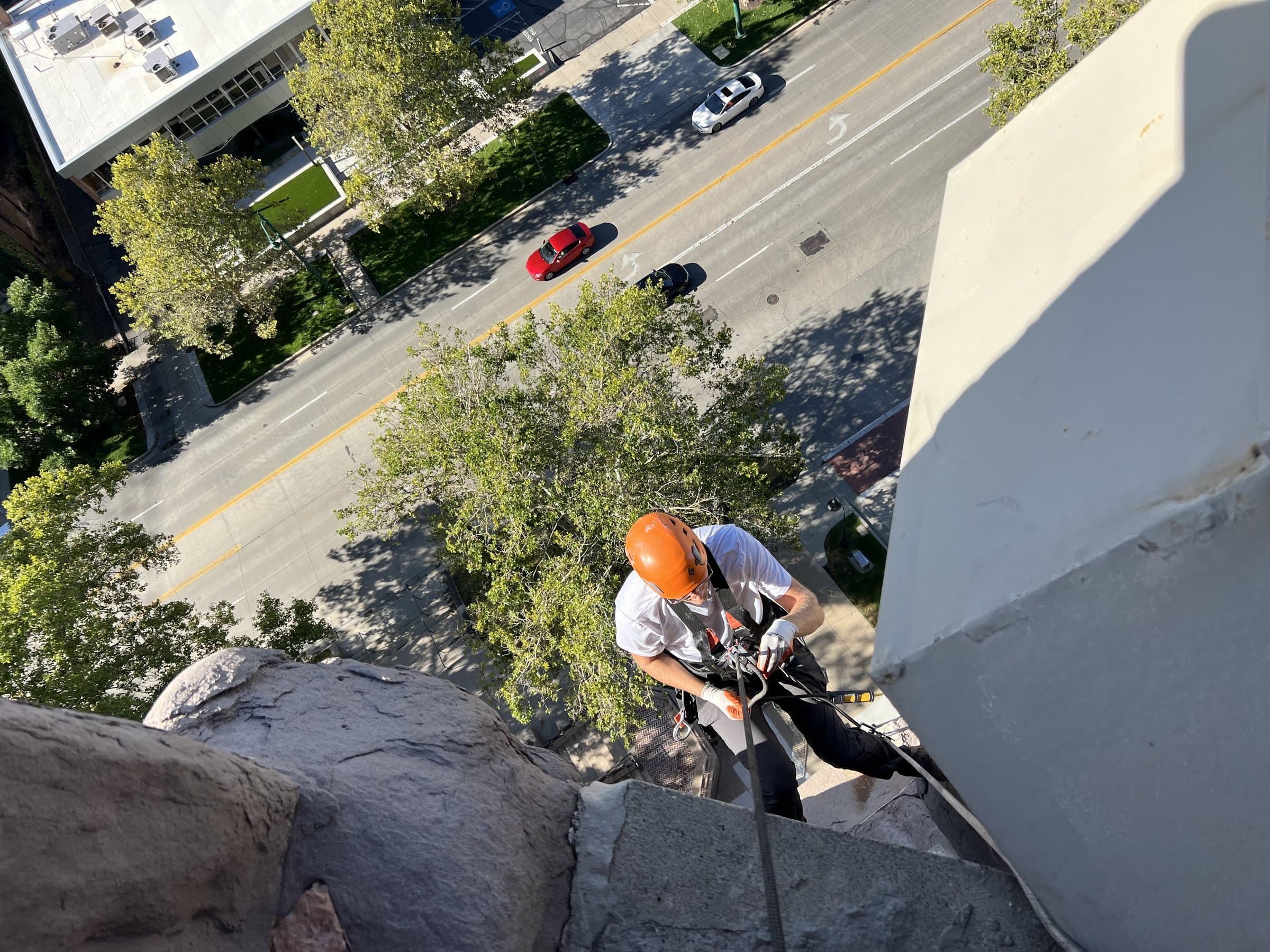
- High-rise / rope-access capacity for elevated buildings
- We finish failed prior jobs—remove old foam and devices
- Two-year written warranty on sealed whole-structure work
- Local eastern WA ownership, backed by a multi-state team
Typical Selah jobs start with a phone consultation, then an attic inspection, followed by humane exclusion and optional guano cleanup. Commercial properties can use our commercial bat removal program.
Local bat facts for Selah
HistoryLink says Selah residents voted 63–0 to incorporate in March 1919, after boosters counted fall harvest workers to reach the 300-resident threshold, and that Yakima County commissioners validated the result on March 17, 1919. Washington OFM puts Selah’s April 1, 2026 population at 8,680, up from 8,153 at the 2020 census. Under WAC 220-200-100 bats are protected wildlife, but bats in or right next to an occupied building may be removed without a permit.
Who to call in Selah
- Bat in the house or any bat contact: Yakima Health District, 509-249-6541 (business hours) or 509-575-4040, press 1 (after hours). 1210 Ahtanum Ridge Drive, Union Gap.
- Pets and domestic animals: City of Selah Animal Control Officer, Selah Police Station, 617 S. First Street, 509-698-7337 (weekdays); after hours call dispatch at 509-574-2500. The city does not handle wild animals. Unincorporated Yakima County: Yakima County Animal Control, 509-574-2420.
- Wildlife questions: WDFW South Central Region 3 office, 1701 S. 24th Ave., Yakima, 509-575-2740 (serves Yakima County).
- Bats living in the attic or walls: A private wildlife control operator. WDFW does not remove bats; it refers homeowners to nuisance wildlife control operators.
Sources
- Yakima Health District – Contact & 24/7 reporting line
- City of Selah – Animal Control
- City of Selah – Police
- HistoryLink – Selah thumbnail history
- HistoryLink – Selah’s incorporation is approved (1919)
- Washington State DOH – Rabies activity in Washington
- WDFW – Regional offices (South Central Region 3)
- WDFW – Hiring a Wildlife Control Operator
- WDFW – Living with wildlife: Bats
- Washington OFM – April 1, 2026 population of cities, towns and counties
- WAC 220-200-100 – Wildlife classified as protected
Selah bat removal FAQ
Selah & the Upper Yakima Valley
- Yakima bat removal
Yakima Valley
- Union Gap bat removal
Upper Yakima Valley / Yakima County
- Moxee bat removal
Moxee Valley / Yakima County
- Ellensburg bat removal
Kittitas Valley / Kittitas County
- Sunnyside bat removal
Lower Yakima Valley / Yakima County
- Grandview bat removal
Lower Yakima Valley / Yakima County
- Wenatchee bat removal
Wenatchee Valley / Chelan County
- East Wenatchee bat removal
Wenatchee Valley / Douglas County
- Prosser bat removal
Lower Yakima Valley / Benton County
- All service areas
Eastern Washington hub
- Why us
Proof points & team
- How we work
Process steps
- Warranty
Two-year coverage
- FAQ
Common questions
Bat problems in Selah? Let's talk.
Humane exclusion for Selah and the surrounding Upper Yakima Valley / Yakima County. Two-year written warranty on whole-structure work. Same-day often available across the 509.